


Viddah Owino appointed to the Alliance
Viddah Owino appointed as the Global Alliance for Communities Lead

The Global Alliance for Communities is pleased to announce the appointment of Viddah Owino as its new Lead, strengthening the Alliance’s leadership at a critical moment of growth and consolidation.
Viddah joins the Alliance as it continues to expand its role as a global coalition of more than 250 grassroots-led organizations working across the Global South to advance community-driven solutions and rebalance how funding, influence, and decision-making flow to the local level.
At a glance
- Seasoned humanitarian and development leader with deep experience across health systems, emergency response, program development and regional policy engagement
- Brings over 15 years of senior leadership experience across Africa and fragile contexts
- Strong track record advancing localization, and equitable partnerships and translating regional and global policy into practical, community-driven delivery
- Primed to immediately lead implementation and strategic growth across the Alliance
A values-driven leader with deep regional expertise
Viddah brings more than 15 years of senior leadership experience across humanitarian response, public health, nutrition, WASH, and emergency preparedness. Most recently, she served as Regional Migration Health Officer for East, Horn, and South Africa at IOM – UN Migration, supporting regional bodies including IGAD, the East African Community, the African Union, and SADC to develop and implement migration and cross-border health policies. Previously, she spent nine years with the International Rescue Committee in Kenya as National Program Lead for Nutrition, WASH, and Emergencies, leading multi-sectoral portfolios, emergency preparedness, and partnerships with governments, donors, UN agencies, and local organisations. Her earlier roles with AMREF Health Africa, Save the Children UK, and World Vision further reflect deep experience in community-based delivery and policy engagement.
“I am truly honored to join the Global Alliance for Communities at a pivotal moment when there is growing recognition that lasting change is driven by communities themselves. Throughout my career, I have consistently seen that the most effective and impactful policies, funding, and systems are those shaped by local leadership and rooted in lived experience. I am excited to work alongside grassroots leaders across the Global South to drive strong implementation, center frontline evidence and advocacy, and build credible partnerships that position the Alliance as a trusted and influential bridge between communities and the institutions seeking to support them.”
– Viddah Owino
Leading implementation across the Alliance
Viddah will provide strategic leadership to operationalize the Alliance’s vision and steer its next phase of growth.
Her focus will include:
- Designing and embedding the Alliance’s operating model, governance structures, and systems to enable effective, member-driven implementation
- Guiding the Alliance’s strategic direction to ensure locally led priorities are translated into credible, scalable action across regions
- Positioning the Alliance as a trusted global platform that consolidates frontline evidence, learning, and advocacy from its membership
- Shaping high value partnerships with funders, research institutions, multilaterals, and the private sector that align resources with community leadership
- Strengthening the Alliance’s external influence and visibility, ensuring it is recognised as a credible bridge between grassroots communities and decision-making institutions
The Global Alliance for Communities looks forward to welcoming Viddah Owino into this role and to the leadership she will bring as the Alliance continues to grow and deepen its global influence.

Earth Day: Local Communities, Youth Must Be at the Centre
As climate change intensifies across Africa, it is local communities who are most affected and who hold the greatest potential to lead sustainable, adaptive solutions. Yet, global and national climate efforts continue to exclude their voices.
In Kenya, a country experiencing historic droughts, flooding, and urbanization pressures, the exclusion of community-based organizations (CBOs), Indigenous knowledge holders, and young people from decision-making threatens the very success of climate adaptation initiatives.
The Global Alliance for Communities, a coalition of grassroots leaders, calls on policymakers and international organizations to take immediate steps to recognize the potential of local leaders to lead sustainable, adaptive climate solutions. To truly build climate resilience, we must:
- Centre Indigenous and local knowledge in climate adaptation frameworks: Policy design and scientific research must integrate traditional practices and wisdom that have long sustained communities in harm with their environment.
- Upskill young people for green jobs and climate leadership: Climate resilience offers an urgent opportunity to address youth unemployment. Policymakers must prioritize upskilling young people for green jobs, create space for their ideas and leadership, and invest in the climate solutions they are already building in their communities.
- Redesign programs through localization partnerships: Engage local organizations from the outset, not only as implementers, but as agenda-setters. Co-create interventions that are culturally relevant, gender-responsive, and designed for long-term community ownership.
- Invest in knowledge exchange and capacity-sharing platforms: Create formal mechanisms for CBOs and young leaders to share insights, learnings, and climate strategies across borders and with government and multilateral actors.
These recommendations are not abstract ideals. They are grounded in what is already working, as our members from Western Kenya expound, in this special feature.
Grassroots climate action
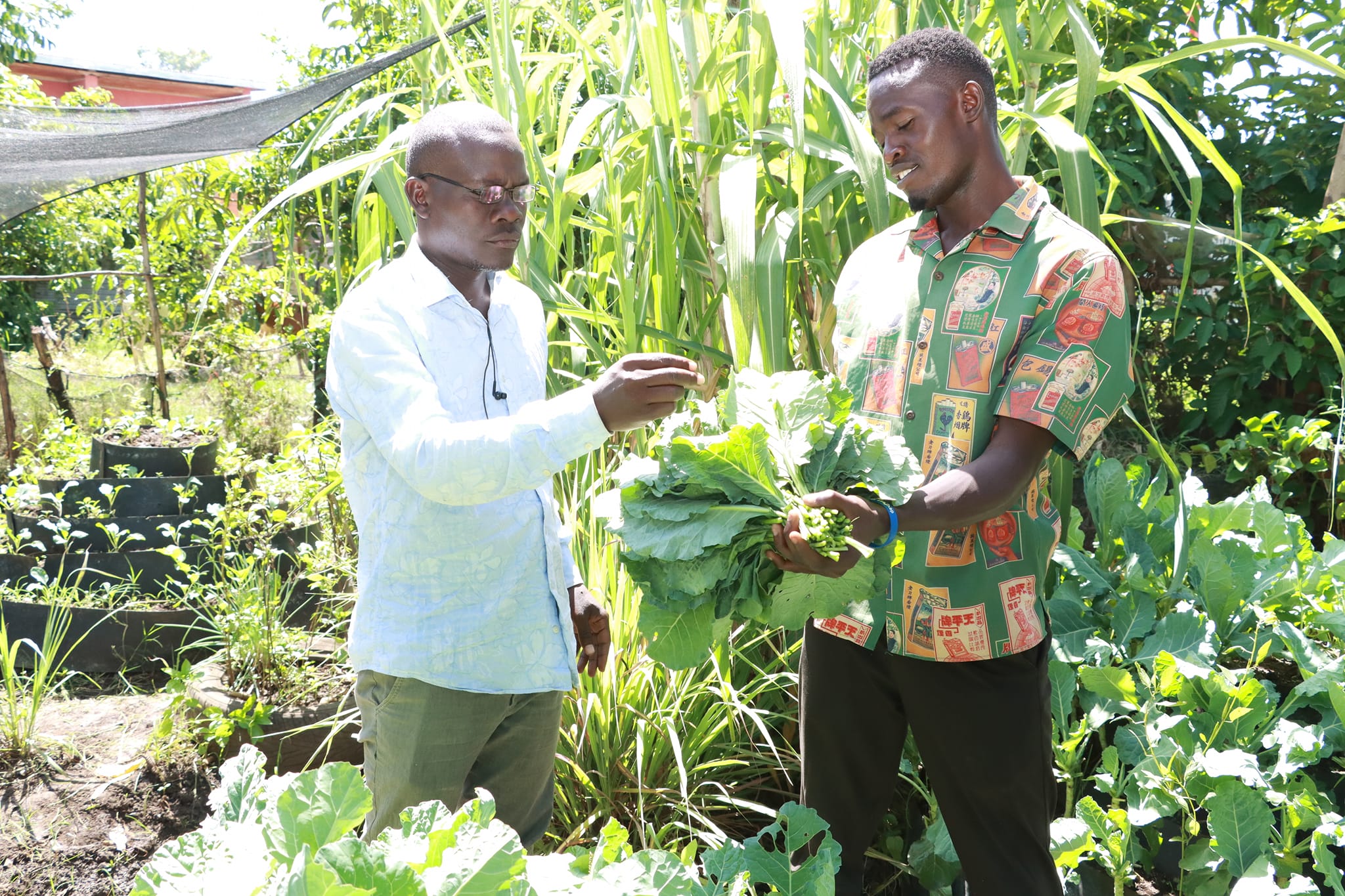
Across Kenya, local organizations are driving climate action in the most challenging environments. In Kibera, young people are clearing rivers of waste to reduce flooding and create green spaces in overcrowded areas with no municipal services. In rural areas, community leaders are constructing water pans for climate-smart irrigation, distributing drought-resistant seeds, and using hydroponics and rooftop gardens to increase food security.
As Alliance member Evance Okoth, founder of Manyatta Metameta Community Based Organization explains, grassroots leaders are driving climate action by designing location-specific programs that address the dual challenges of youth unemployment and food insecurity through climate-responsive urban agriculture.
“Our organization is a testament to how grassroots efforts can drive meaningful change in food security. By empowering local communities with knowledge and resources, we have not only addressed hunger but also fostered economic growth and social cohesion in Manyatta’s informal settlements.”
Others are turning food waste into organic fertilizer and raising black soldier flies to reduce emissions and generate income. These are low-cost, high-impact solutions that respond to lived realities.
Government support is crucial
Communities living along the Lake Victoria Basin are disproportionately affected by climate change, particularly flooding and pollution that flows downstream from industrial and urban centers. Hellen Oyuko, a project officer at United Waste Solutions, explains that as grassroots organizations continue to work with communities on climate response and conservation, stronger government support is crucial to handling their most pressing challenges.
“The greatest challenges faced in our work is pollution from diverse sources such as industries and households due to varying regulations and enforcement issues. Inadequate information on river systems and their health makes it difficult to design effective and targeted conservation strategies. Inadequate policy implementation and lack of coordination among agencies greatly undermines environmental conservation measures.”
Alliance member Barack Dominic Oluoch of Kambare Youth Intervention emphasizes that local governments must recognize the expertise of grassroots organizations, particularly youth-led initiatives, by giving them a seat at decision-making tables.
“The key game changer will be where the government helps grassroots communities navigate legal and political systems to advocate for their rights and the environment which enable communities to give feedback as they also see their input reflected in program adjustments. If we listen to Iocal communities and young people who have protected nature for generations, we will protect the future.”
Fund local climate action
Despite the impact of climate change on local communities, adaptation remains vastly underfunded. Only 5% of global climate finance is directed to adaptation, and of that, just 20% reaches Africa. Community organizations receive only a fraction of this already limited funding.
As grassroots mobilizer Gladys Akinyi points out, the consequences of this gap must be viewed through a climate justice lens, by centering the lived experiences of the communities most affected. “We need to understand that climate justice means recognizing that while the climate crisis affects us all, it does not affect us equally. It means seeing the farmer in a drought-stricken region, children growing up near toxic air, and the island nation losing its shores not as footnotes, but as the frontline voices of this crisis."
Speaking from Kisumu, where she runs the United Destiny Shapers CBO, Gladys called for urgent funding support for local climate action. She emphasized that communities cannot be expected to adapt while being left out of the conversation and cut off from critical resources.
“We need support that is context-aware. Conservation projects often require long-term financial investment, which becomes difficult to secure—especially in developing areas like Kisumu, where rural-urban migration is high. Funding should also be in support of multi-year programs instead of short-term projects to ensure lasting impact and continuity.”
Top-down solutions imposed without community input will continue to fail. Trusted local leaders may not be climate scientists, but they know their people, their land, and their risks. Their legitimacy, reach, and cultural understanding make them the most effective actors to lead adaptation.
The next generation of climate leaders will come from Africa. They are already building solutions in riverbeds, rooftops, and informal settlements. What they need now is for governments and international actors to shift power, fund their work, and listen—before the window of opportunity closes.
Signed: The Global Alliance of Communities and Member Organizations
- Gladys Akinyi, Programs Lead, United Destiny Shapers CBO
- Barack Domnic Oluoch, Programs Manager, Kambare Youth Intervention
- Hellen Oyuko, Project Officer, United Waste Solutions
- Evance Okoth, Founder, Manyatta Metameta CBO
Unveiling our five-year strategy
We are pleased to share the launch of our five-year strategy, which marks a pivotal moment in our journey towards empowering grassroots organizations and advocating for locally-led development on a global scale.
Developed in collaboration with our extensive membership through a series of intensive workshops and consultations, this strategy outlines objectives to enhance the Alliance’s effectiveness and reach. It focuses on advocacy for community-driven solutions, capacity building for grassroots organizations, and amplifying their voices globally.
Strategic architecture
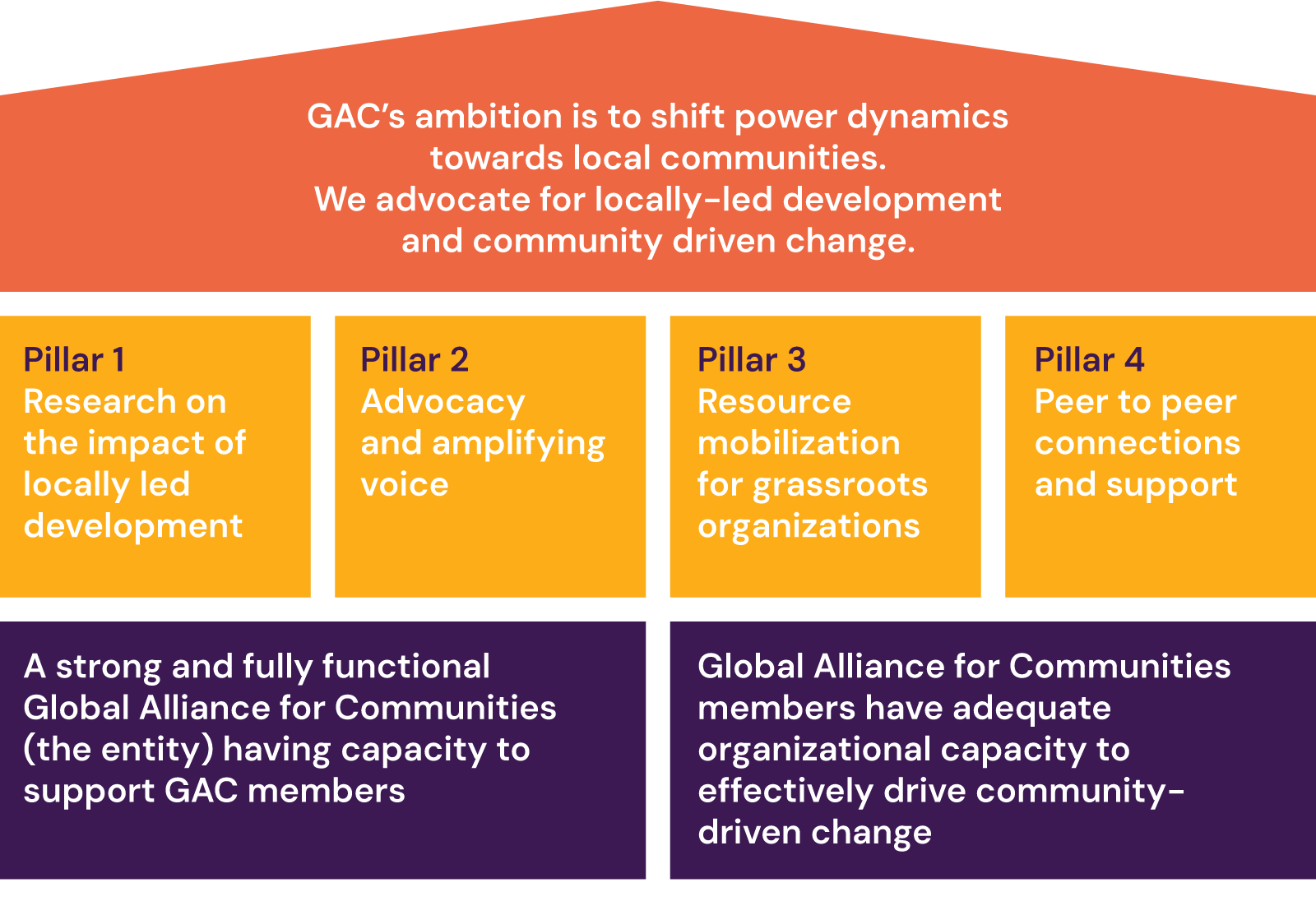
Strategic ambition:
Our ambition is to shift power dynamics towards local communities. We advocate for locally-led development and community driven change.
The four strategic pillars:
- Research on the impact of locally-led development
- Advocacy and Amplifying Voice
- Resource Mobilization for grassroots organizations
- Peer to Peer Connections & Support
Foundation:
- A strong and fully functional Global Alliance for Community (the entity) having capacity to support members
- Members have adequate Organizational Capacity to drive Community driven change effectively
The five-year strategic objectives
Foundational objectives
Our strategic objectives are firmly grounded in four key foundational objectives that set the fundamental groundwork for enhancing organizational capabilities, securing resources, building credibility, and strengthening member organizations. These foundational pillars support the Alliance’s broader strategic ambition, ensuring robust operational structures, sustainable funding, trusted partnerships, and impactful community engagement.
- Increase trust, credibility, and legitimacy by enhancing visibility and credibility in the local development space, fostering strategic partnerships with key stakeholders and funders, and promoting the Alliance as a trusted entity representing grassroots voices globally.
- Increase organizational capacity by establishing a robust secretariat team and operational structures, developing governance mechanisms for effective oversight and advisory support, and strengthening SHOFCO’s support role in incubating the Alliance’s growth.
- Secure adequate financial resources through ensuring sustainable funding for operational and strategic priorities, advocating for accessible and unrestricted funding mechanisms, and enhancing financial transparency and accountability.
- Enhance member organization capacity by conducting organizational capacity assessments for CBO members, supporting organizational growth and autonomy, and expanding outreach and impact through enhanced program quality and community engagement.
Strategic objectives
Objective 1: contribute to evidence-based locally led development
We conduct research with learning institutions at the grassroots level to enhance understanding of proximate leadership’s impact, community-driven solutions, and effective measurement of social impact, informing evidence-based policy and advocacy initiatives and playing a pivotal role in shaping informed policy decisions.
- Goal 1.1: Cultivate research partnerships with 2 or 3 academic or research organizations
- Goal 1.2: Members contribute to 5 research papers and/or white papers relating to locally led development and/or community driven solutions & impact
- Goal 1.3: Use research and knowledge products for advocacy and influencing efforts (i.e. campaigns) as well as awareness building (i.e in local media)
- Goal 1.4: Develop a database featuring research supported or contributed by members
Objective 2: amplify voices and drive change through campaigns and advocacy
We will amplify proximate leaders’ and grassroots organizations’ voices through campaigns, advocacy, and partnerships with academic and civil society entities, driving global awareness, support mobilization, and policy change in community development.
- Goal 2.1: We identify and uplift grassroots issues and voices in advocacy efforts.
- Goal 2.2: We increase opportunities for media engagement for members to further their reach.
- Goal 2.3: We increase visibility for members and proximate leaders by offering them a platform to speak on their work.
- Goal 2.4: We are working towards shifting the mindset of the global north on the importance of locally-led development.
Objective 3: increase availability and access to funding and resources
We aim to enhance funding accessibility for grassroots organizations and leaders of color from the Global South, fostering racial equity accountability among funders by providing trusted intermediary support through insights, resources, and capacity-building initiatives globally.
- Goal 3.1: Increase the visibility of grassroots organizations and enhance their access to funding opportunities
- Goal 3.2: Provide a platform for learning about funding opportunities and accessing funders
- Goal 3.3: Influence funders to offer more accessible and unrestricted funding mechanisms
- Goal 3.4: Connect with international funders/organizations through influencing and advocacy efforts
Objective 4: increase peer-to-peer connections and collaboration
We are fostering collective learning and capability building among community-based organizations through extensive knowledge sharing, peer-to-peer connections, and collaborative partnerships across impact areas and geographies, promoting unified action and impactful projects on a global scale.
- Goal 4.1: Establish and promote online platforms (Resource hub, member portal, member directory) for connection and learning as well as resource sharing
- Goal 4.2: Increase the number of collaborations/partnerships/consortiums established amongst members
- Goal 4.3: Increase peer to peer connections and learning within and across impact areas and geographies.
- Goal 4.4: Have established and functioning Impact Area Clusters